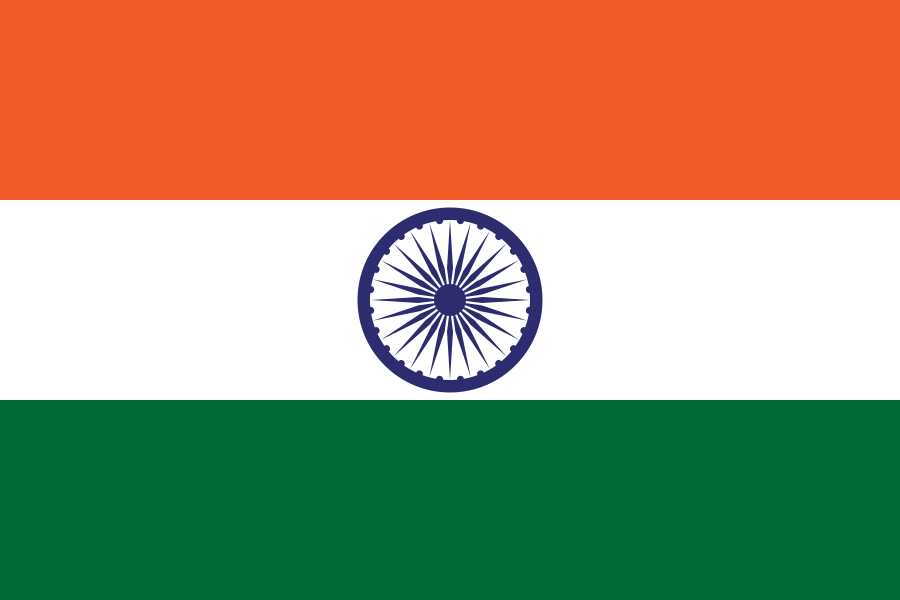

Jai Hind!
Celebrating 77 Years of the Sovereign, Socialist, Secular, and Democratic Republic of India.
Create your digital greeting card now.
Significance of January 26
Republic Day marks the date on which the Constitution of India came into effect on 26 January 1950, replacing the Government of India Act (1935) as the governing document of India and thus, turning the nation into a newly formed republic.
The Constitution was adopted by the Indian Constituent Assembly on 26 November 1949 and came into effect on 26 January 1950 with a democratic government system, completing the country's transition towards becoming an independent republic. 26 January was chosen as the date for Republic Day because it was on this day in 1930 when the Declaration of Indian Independence (Purna Swaraj) was proclaimed by the Indian National Congress as opposed to the Dominion status offered by the British Regime.
The main Republic Day celebration is held in the national capital, New Delhi, at the Kartavya Path before the President of India. On this day, ceremonious parades take place at the Kartavya Path, which are performed as a tribute to India; its unity in diversity and rich cultural heritage.
History of the Constitution
-
1
The Constitution of India is the longest written constitution of any country in the world, containing 448 articles in 25 parts and 12 schedules.
-
2
Dr. B.R. Ambedkar is known as the "Father of the Indian Constitution" for his pivotal role as the Chairman of the Drafting Committee.
-
3
The original copies of the Constitution were not printed but handwritten and calligraphed in both English and Hindi.
-
4
It took precisely 2 years, 11 months, and 18 days for the Constituent Assembly to finalize the Constitution.
-
5
The original copies are kept in special helium-filled cases in the Library of the Parliament of India to prevent oxidation and decay.
